You may have seen hair transplant clinics recommend FUE or FUT and wondered which one works better. Both methods move hair from the donor area to thinning parts of the scalp. The biggest difference is how surgeons collect those hairs. However, understanding the causes of hair loss in men and women is equally important before considering a transplant, as the underlying reason can influence long-term treatment planning. FUE removes small groups one by one, while FUT takes a thin strip of scalp first.
That difference affects scars, healing, and the number of grafts a surgeon can collect. So, which is right for your hair loss? This guide compares both techniques, explains their costs and recovery, and helps you ask better questions before booking a consultation in Chandigarh.
What Is the Difference Between FUE and FUT Hair Transplant?
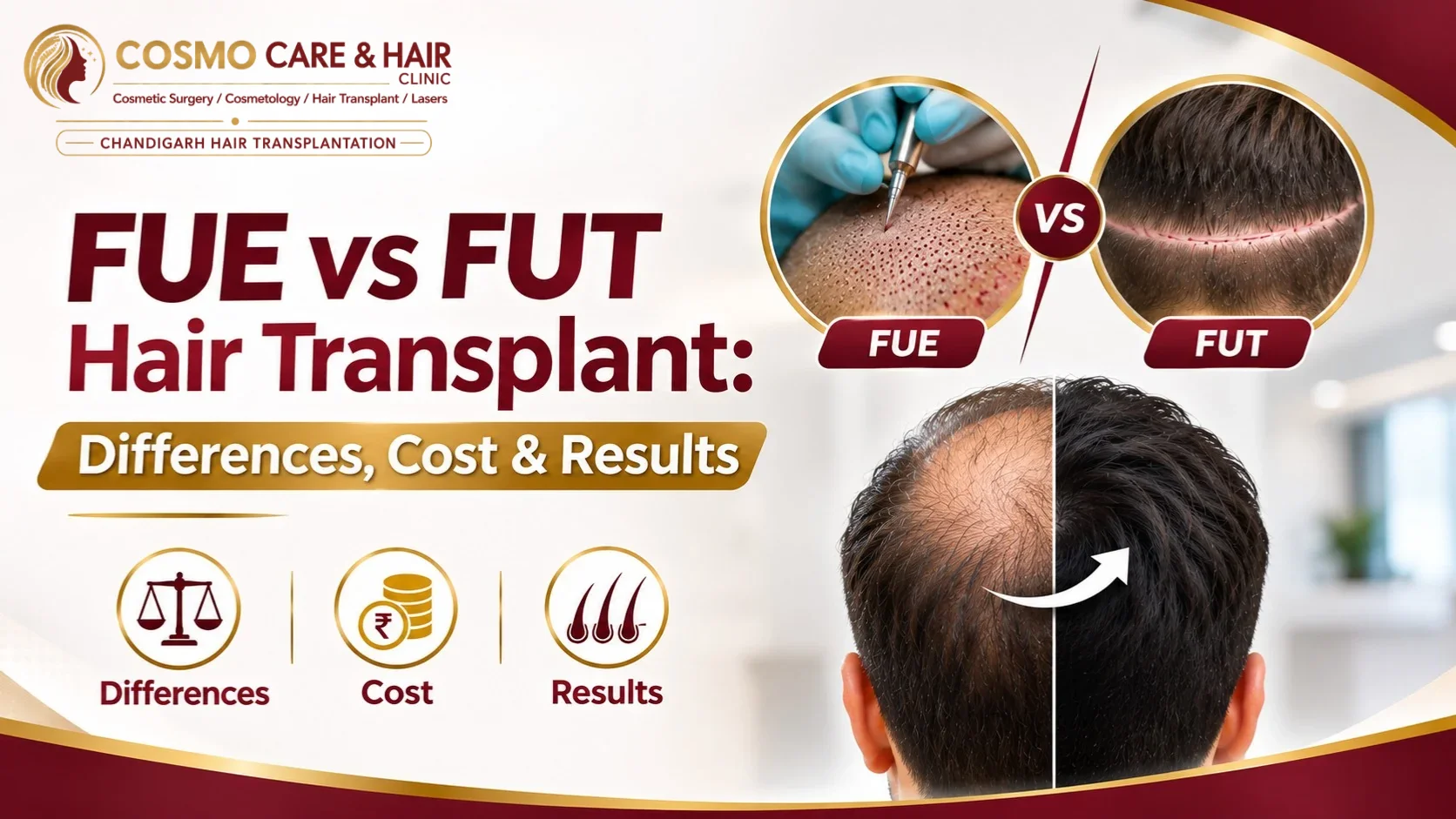
The major distinction between the two is in how the surgeon obtains the hair grafts. In FUE (Follicular Unit Extraction), the surgeon extracts hair follicle clusters one at a time from the donor site.
In FUT (Follicular Unit Transplantation), the doctor excises a strip of scalp and separates it into individual follicles. Both methods then place those grafts into areas affected by hair loss. Here’s how they compare.
Both are not without scars either. Moreover, one procedure does not guarantee thicker or more natural hair. It depends on the expertise of the surgeon, the quality of the grafts, the donor hair, and the overall procedure.
How Do FUE and FUT Hair Transplant Procedures Work?
Both procedures move healthy hair follicles from a donor area, usually the back or sides of the scalp, to areas with thinning hair. The difference lies mainly in how those follicles are collected.
How Does an FUE Hair Transplant Work?
During FUE, the surgeon uses a small circular tool to remove follicular units one at a time. Each unit contains one or more hairs. The team then prepares the grafts and places them into the thinning area.
Because the surgeon makes many tiny openings rather than one long cut, FUE leaves small, scattered scars. This approach often suits people who prefer short hairstyles or want to avoid a long scar. However, removing too many grafts from one area can make the donor region look thin. Careful planning matters.
How Does an FUT Hair Transplant Work?
During FUT, the surgeon removes a thin strip of skin containing hair follicles from the donor area. The wound is then closed with stitches or staples. Next, the surgical team divides the strip into individual hair grafts under magnification.
These grafts are placed in the areas that need more hair. FUT can help collect a large number of grafts while keeping the harvesting area more concentrated. However, it leaves a linear scar. Patients who keep their hair longer can often cover it.
What Are the Advantages and Disadvantages of FUE and FUT?
Both techniques can provide natural-looking results. However, their benefits and limitations differ.
Advantages and Disadvantages of FUE
The biggest advantage of FUE is that it avoids a long donor scar. Its small extraction sites usually heal faster than a strip incision. Donor-area discomfort may also be lower. FUE can be a good choice if you:
- Prefer short hairstyles
- Want to avoid a linear scar
- Have limited scalp flexibility
- Need a suitable number of grafts from an available donor area
However, FUE can take considerable time when many grafts are needed. The donor area may also require shaving, although some clinics offer limited-shave techniques.
One important point: Tiny scars still form where grafts are removed. FUE should never be described as scarless.
Advantages and Disadvantages of FUT
FUT can be useful when a patient needs a larger number of grafts and has suitable donor hair. The method also allows the team to prepare grafts from a strip under a microscope. Another benefit is that patients may not need to shave a large donor area. However, the surgical cut takes longer to heal.
You may also feel tightness or discomfort around the stitches during early recovery. The linear scar is another consideration, especially if you like very short haircuts. FUT isn’t automatically better for advanced hair loss. The surgeon must also check your scalp flexibility, donor density, and future hair loss risk.
Which Is the Best Hair Transplant Technique for You?
The best hair transplant technique depends on your donor hair, degree of hair loss, hairstyle, and long-term goals. Instead of asking which procedure is more advanced, ask which one suits your scalp.
The Donor Hair and Hairstyle Test
Here’s something many patients overlook: How will your donor area look five or ten years after surgery? A transplant doesn’t create new hair. It moves existing follicles from one area to another. That means your donor supply is limited. Depending on the type and progression of hair loss, a surgeon may also discuss non-surgical treatment options such as minoxidil for hair growth as part of an overall hair management plan. Before choosing a technique, consider these questions:
For example, a 28-year-old with a receding hairline may need a different plan from someone aged 45 with stable hair loss. Since the right age for a hair transplant depends on factors such as hair loss progression, donor hair availability, and long-term planning, younger patients may need additional consideration before surgery.
Using too many grafts early may reduce future options. The best procedure isn’t simply the one that covers today’s bald patch. It should also protect tomorrow’s donor supply. A qualified surgeon can assess this during consultation.
How Does Recovery Differ Between FUE and FUT?
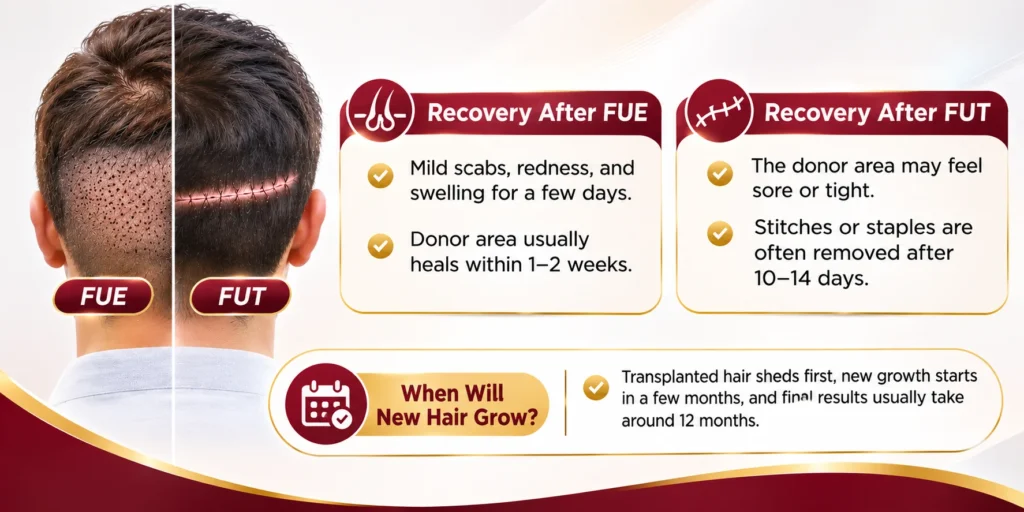
FUE generally offers faster healing at the donor area. FUT often needs more time because the surgeon closes a strip incision with stitches or staples. However, recovery varies between patients.
Recovery After FUE
You may notice small scabs, redness, and mild swelling during the first few days. The donor area often improves within one to two weeks. Your surgeon will explain when you can wash your hair, exercise, and return to work.
Recovery After FUT
The donor area may feel sore or tight after surgery. Stitches or staples often need removal after roughly 10-14 days, depending on the closure method. You may also need to avoid heavy exercise for longer to protect the healing incision.
When will new hair grow?
With either technique, transplanted hairs often shed during the first few weeks. New growth develops gradually over the following months. Final results commonly take around 12 months, sometimes longer. Do not judge your transplant’s success by how your hair looks after just four weeks.
What Is the Difference Between FUE and FUT Hair Transplant Cost?
FUE often costs more than FUT because removing individual grafts takes time and specialised equipment. However, the actual hair transplant cost depends on more than the technique, including the number of grafts, surgeon’s experience, and treatment requirements.
Your quotation may reflect:
- Number of grafts required
- Surgeon and surgical team experience
- Donor area condition
- Procedure complexity
- Clinic facilities and follow-up care
A lower price per graft doesn’t always mean better value. For example, a patient who needs fewer grafts may have a lower total cost with FUE than someone requiring extensive FUT treatment.
Therefore, compare the complete treatment plan rather than focusing only on the advertised rate. Also, ask who will perform the surgical steps and what the quoted package includes.